Disability insurance: the four numbers that decide your benefit, and the tax detail that changes it
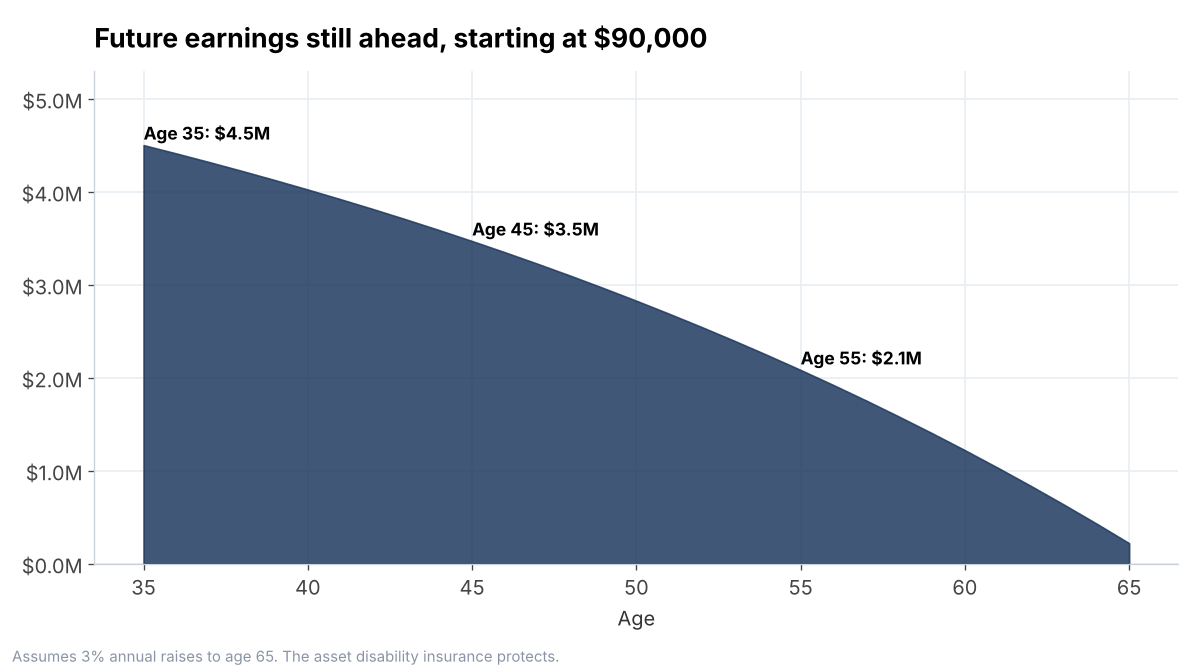
Most working people insure their house, their car, and their life, and leave the asset worth more than all three uninsured: their ability to earn. A 35-year-old earning $90,000 with modest raises has roughly $4.5 million of earnings ahead of them before 65. Disability insurance protects that stream when an illness or injury stops you from working.
This guide covers the four numbers that decide what a disability policy pays: the replacement percentage, the elimination period, the benefit period, and the definition of disability. It also looks at the tax detail that changes your take-home benefit.

The asset you're protecting
Disabilities that last months or years are more common than many people assume, and many come from illnesses such as cancer, heart disease, and back problems rather than accidents. Workers' compensation only covers work-related injuries, and Social Security disability has a strict definition and a long approval process.
The four numbers that decide the benefit
Replacement percentage. Most policies replace 50% to 70% of income, not 100%. Insurers want you to have a reason to return to work. Group policies often pay 60% up to a monthly maximum.
Elimination period. The waiting time between becoming disabled and the start of benefits, like a deductible measured in days. Common choices are 30, 90, and 180 days. Longer is cheaper.
Benefit period. How long benefits last: 2 years, 5 years, or to age 65 or 67. Short-term disability usually covers a few months. Long-term disability covers the rest.
Definition of disability. - Own occupation: you're disabled if you can't do the main duties of your job, even if you could do another one. - Any occupation: you're disabled only if you can't do any job you're reasonably suited for by education and experience.
Many group policies use own-occupation for the first two years, then switch to any-occupation. Individual policies can offer own-occupation for the whole benefit period at a higher price. For specialized professionals, this is often the most important feature.
The elimination period in practice
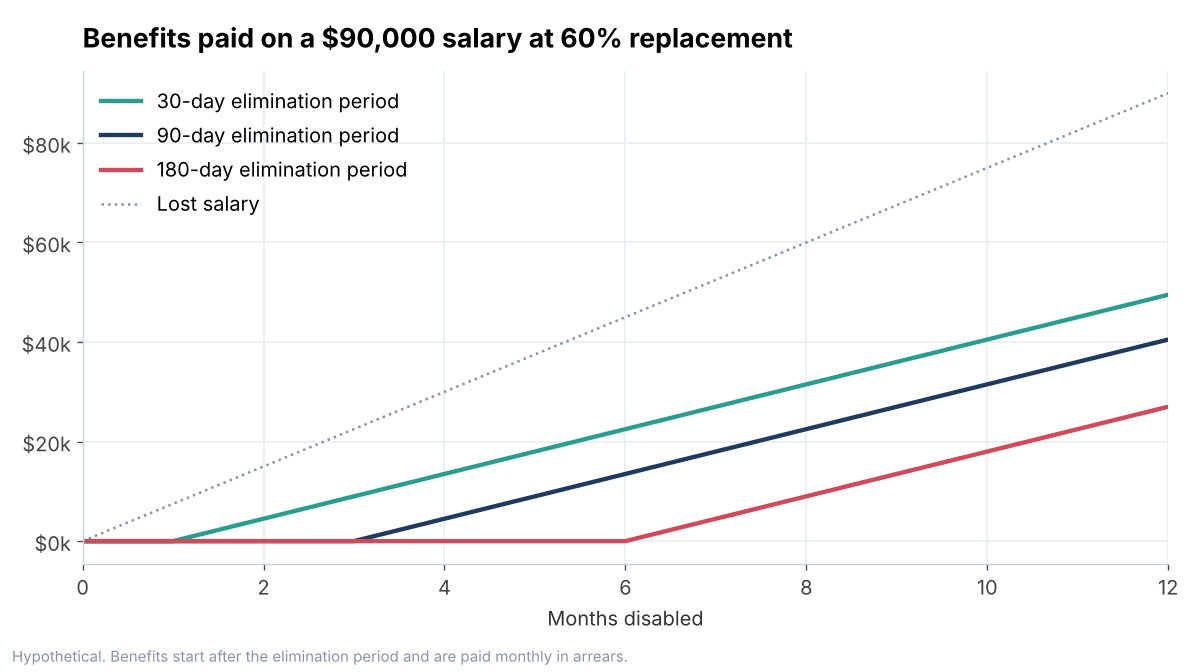
On a $90,000 salary, a 90-day elimination period means about $22,500 of lost salary before the first benefit, and benefits are usually paid monthly after that. An emergency fund of three to six months of expenses and a 90-day elimination period work well together. With little savings, a shorter elimination period, or short-term disability coverage from an employer, fills the gap.
The tax detail
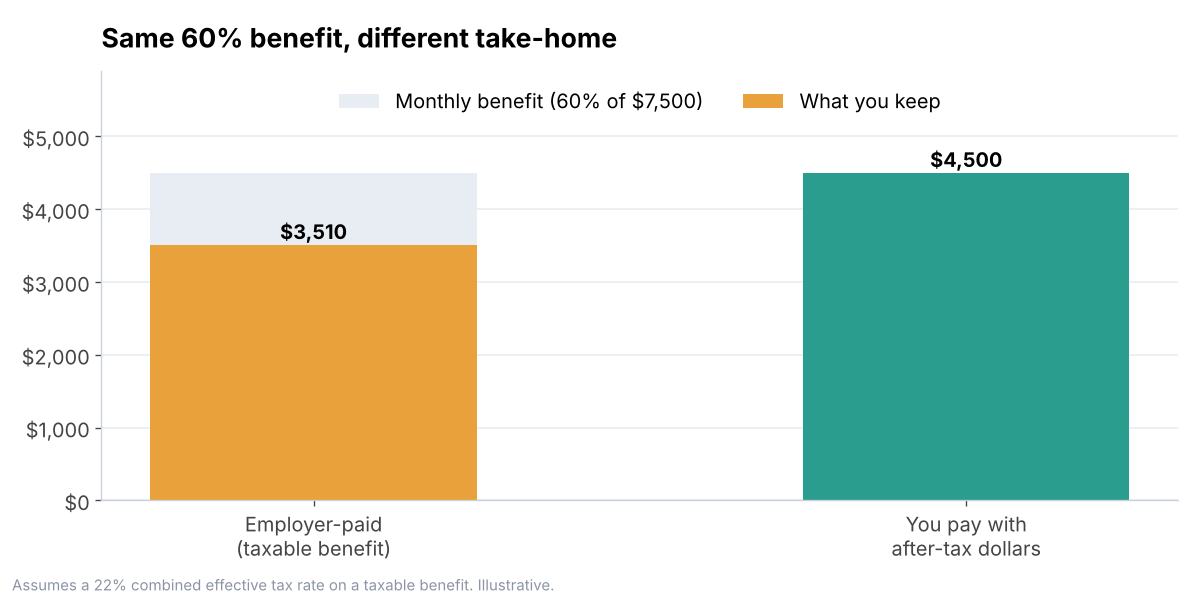
- If your employer pays the premium, or you pay it with pre-tax dollars, benefits are generally taxable income.
- If you pay the premium with after-tax dollars, benefits are generally tax-free.
Some employers let you choose to have the premium included in your taxable pay so the benefits will be tax-free. It costs a little in taxes each year and can make a large difference if you ever claim.
For a fuller explanation of short-term and long-term coverage, group versus individual policies, and riders, see this guide to disability insurance.

Group coverage vs. an individual policy
| Typical group long-term disability | Typical individual policy | |
|---|---|---|
| Cost | Often employer-paid or cheap | You pay, more expensive |
| Replacement | Often 60%, with a monthly cap | Set when you buy, within insurer limits |
| Definition | Often own occupation for 2 years, then any occupation | Own occupation available for the full benefit period |
| Portability | Usually ends with the job | Stays with you |
| Taxation | Often taxable | Usually tax-free if paid with after-tax dollars |
| Underwriting | Usually none | Medical and financial underwriting |
Many people use both: the group policy as a base and an individual policy on top to cover the gap above the group cap, and to keep coverage if they change jobs.
A worked gap check
A $150,000 earner has a group policy that pays 60% up to $6,000 a month. Their salary is $12,500 a month, so 60% would be $7,500, but the cap limits the benefit to $6,000. The benefit is taxable, so at a 25% effective rate they'd keep about $4,500 a month, about 36% of gross salary. If their household needs $7,500 a month to cover fixed costs, an individual policy of around $3,000 a month, paid with after-tax dollars, would close most of the gap.
Riders worth knowing
- Residual or partial disability: pays a partial benefit if you can work, but with reduced hours or income.
- Cost-of-living adjustment: increases benefits during a long claim to keep up with inflation.
- Future increase option: lets you buy more coverage as your income grows without new medical underwriting.
- Non-cancelable and guaranteed renewable: the insurer can't cancel the policy or raise the premium as long as you pay. Guaranteed renewable alone protects against cancellation but allows class-wide price increases.
Checking your coverage
- Find your employer's long-term disability plan summary.
- Note the replacement percentage and the monthly maximum. High earners often find the maximum caps their benefit well below 60%.
- Check the elimination period and benefit period.
- Check the definition of disability and when it changes.
- Find out whether benefits will be taxable.
- Compare the result with your actual monthly expenses.
- If there's a gap, price an individual policy to sit on top of the group coverage.
Quick answers
Does disability insurance cover pregnancy? Short-term disability often covers recovery from childbirth. Coverage depends on the policy and when it started.
Is group coverage portable if I change jobs? Usually not. Group coverage typically ends with the job. Individual coverage stays with you.
Do I need it if I have savings? Savings cover months. Disability can last years. Unless your savings could replace income for many years, disability insurance is usually worth considering.
Sources and further reading
- Social Security Administration: Disability benefits
- U.S. Department of Labor: Disability insurance and employee benefits
- IRS: Publication 525, Taxable and nontaxable income
Hypothetical figures. General information only, not insurance or tax advice.