Laddering term life insurance: matching coverage to a shrinking need
Most families who buy term life insurance buy one policy: a single amount for a single term, often $1 million or more for 20 or 30 years. But the need it covers doesn't stay flat. It's highest when the mortgage is new and the children are young, and it shrinks as the mortgage is paid down, college gets paid for, and savings grow.
A term life ladder matches coverage to that shrinking need by buying several smaller policies with different term lengths. This guide shows how a ladder lines up with a typical need, compares illustrative premiums, adds up 30 years of costs, and covers the trade-offs.

The need shrinks over time
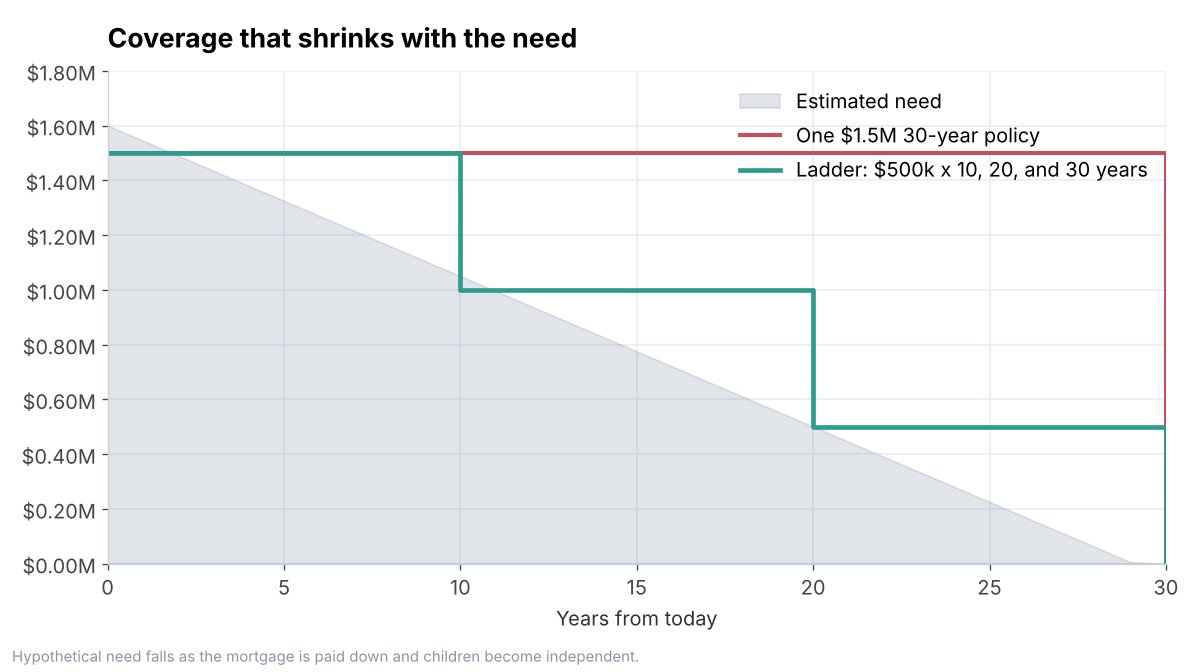
A family with two young children, a new mortgage, and modest savings might estimate its need at $1.6 million today: enough to pay off the mortgage, replace years of income, and fund college. Each year, the mortgage gets smaller, the children get closer to independence, and savings grow. By year 30, the need may be close to zero.
How a ladder works
Instead of one $1.5 million 30-year policy, buy:
| Policy | Term | Coverage | Coverage in force |
|---|---|---|---|
| A | 10 years | $500,000 | Years 1–10 |
| B | 20 years | $500,000 | Years 1–20 |
| C | 30 years | $500,000 | Years 1–30 |
Total coverage is $1.5 million for the first 10 years, $1 million for years 11 to 20, and $500,000 for years 21 to 30.
What it costs
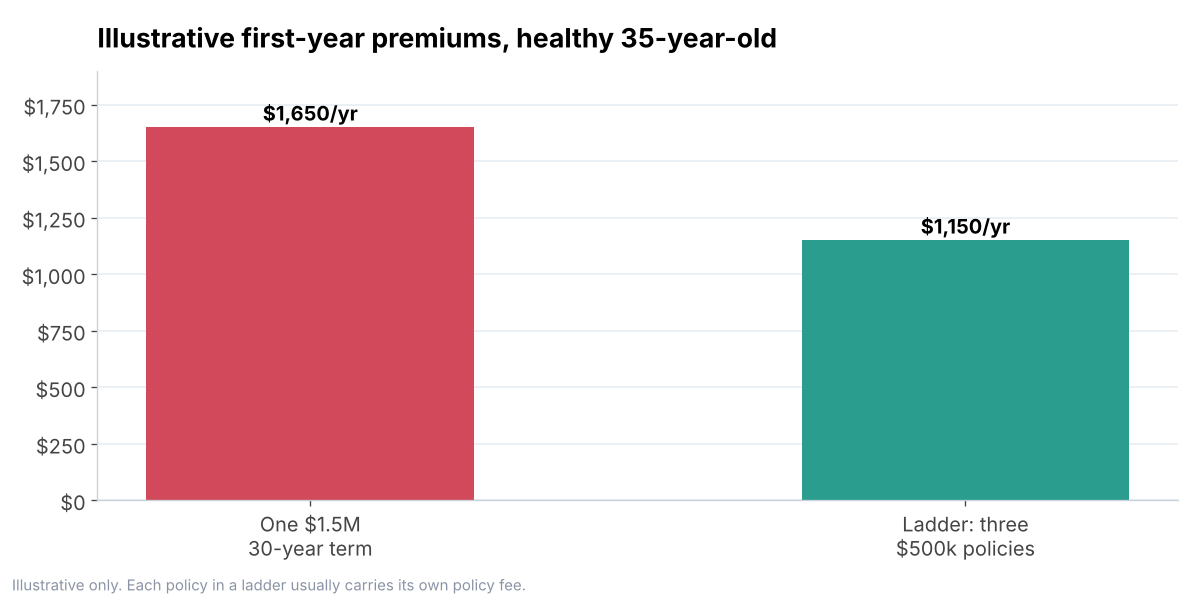
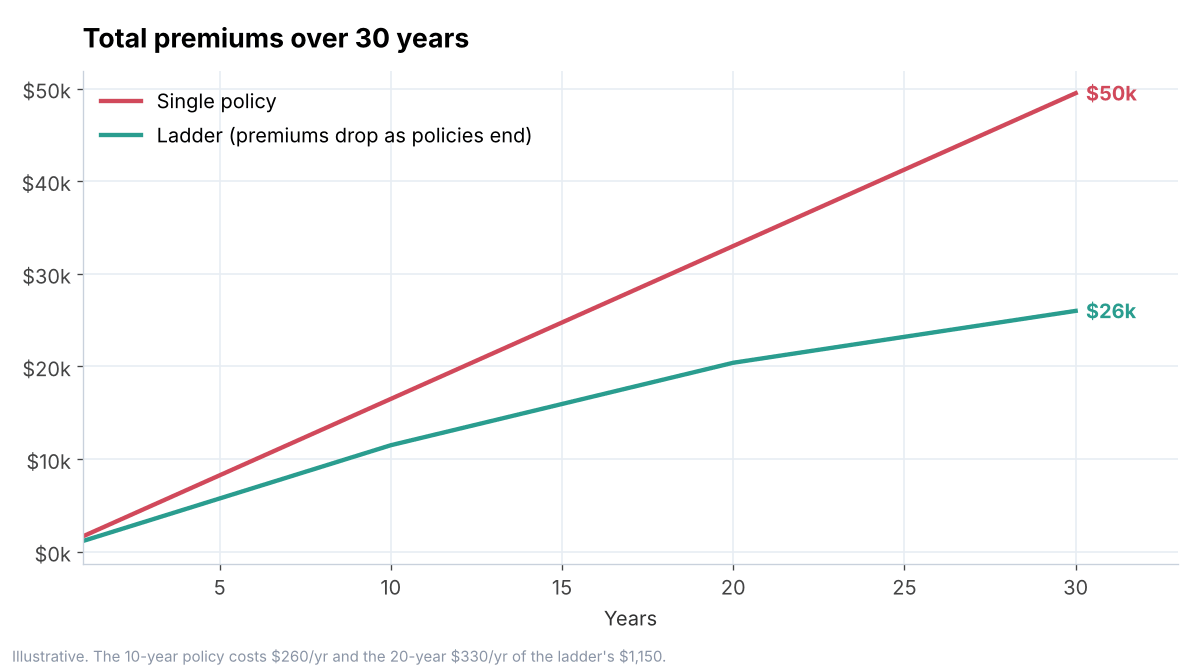
Shorter terms are cheaper because the insurer covers fewer of your older, higher-risk years. In this illustration, the ladder starts about $500 a year cheaper, and the premium drops as each policy ends.
| Years 1–10 | Years 11–20 | Years 21–30 | 30-year total | |
|---|---|---|---|---|
| Single $1.5M policy | $1,650/yr | $1,650/yr | $1,650/yr | $49,500 |
| Ladder | $1,150/yr | $890/yr | $560/yr | $26,000 |
These are illustrative premiums for a healthy 35-year-old. Real prices depend on age, health, insurer, and riders.

Trade-offs
Less coverage later. If the need doesn't shrink as planned, for example because of a later child, a bigger mortgage, or a dependent with special needs, the ladder may leave you underinsured in later years. Buying new coverage at 55 is much more expensive, and may not be possible if your health has changed.
More policies to manage. Three policies mean three premiums, three sets of paperwork, and three beneficiary designations to keep current. Each policy usually also has its own policy fee.
Conversion rights. Many term policies can be converted to permanent insurance without new medical questions, up to a certain age or year. With a ladder, check each policy's conversion window. That flexibility matters if your health declines.
Alternative: one policy you reduce later. Some insurers let you lower the face amount of a single policy over time, which reduces the premium. Ask whether that's allowed and whether it costs anything.
Estimating the need, step by step
A simple way to estimate the need at different points in time:
| Item | Today | In 10 years | In 20 years |
|---|---|---|---|
| Mortgage balance | $420,000 | $300,000 | $150,000 |
| Income replacement (years until youngest is 22 × $70,000) | $1,120,000 | $420,000 | $0 |
| College for two children | $200,000 | $120,000 | $0 |
| Final expenses and debts | $30,000 | $30,000 | $30,000 |
| Minus existing savings and other insurance | −$170,000 | −$350,000 | −$500,000 |
| Estimated need | $1,600,000 | $520,000 | $0 |
In this example the need falls faster than the simple straight line in the first chart, which is common once savings start compounding. A family could reasonably choose a smaller 30-year policy. The point of the exercise is to see the shape of the need, then choose coverage that follows it with a margin for things going worse than planned.
Who shouldn't ladder
- People with a lifelong dependent, such as a child with a disability. The need may not shrink at all.
- People who expect large future obligations, such as a business with debts they've personally guaranteed.
- People whose health is borderline now. If they might be uninsurable later, buying more long-term coverage today can be worth the higher price.
Building a ladder
- Estimate your need today and at 10, 20, and 30 years. Include the mortgage balance, years of income to replace, education costs, debts, and existing savings and insurance.
- Match policies to the main obligations: for example, a 30-year policy for the mortgage, a 20-year policy for the children's dependence years, and a 10-year policy for the early years when savings are thin.
- Get quotes for the ladder and for a single policy, at the same insurer and from several insurers.
- Check conversion options and any riders on each policy.
- Name beneficiaries on each policy and review them after any major life event.
Quick answers
Does a ladder require more medical exams? Usually not. Insurers often underwrite all the applications together, or one exam satisfies several applications at the same time.
Is laddering better than permanent life insurance? They serve different goals. Term ladders are about covering a temporary need cheaply. Permanent insurance is for lifelong needs, such as estate planning.
What if I need more coverage later? You can buy more if you're insurable. That's the main risk of buying less coverage later in life.
Sources and further reading
- National Association of Insurance Commissioners: Life insurance buyer's guide
- Consumer Financial Protection Bureau: Planning for your family's future
- Insurance Information Institute: Life insurance basics
Illustrative premiums. General information only, not insurance or financial advice.